Introduction
Artificial Intelligence is the latest wave of technological innovation marketed and integrated across a myriad of market sectors, business layers, and organization types. Considering the recent traction surrounding A.I., it is important to understand the nature of this analytical processes inherent facets & outright central objectivity. Being generally outlined and understood as being blatantly focused on heightening simplicity. Cornerstones of service learning is grounded in power redistribution, interoperable/collective social change and the development of strong Academic-Community Partnerships. Catalyzing their reach, application, and quality of program/services rendered when hybridized with analytics. Stem-specific branches of service learning would be a primary point of access that directly benefits from the ease of an A.I. led, front-end user accessible software. In Information Technology the opportunity is limitless — all recent innovation has for the last 60 years to date become possible through incremental success’ in the industry.
‘SLAnalytics’, or Service Learning Analytics can enhance the affordability, accessibility, and overall quality of learning through communally centric data driven learning experiences. For example, Sustainable Transportation Engineering can blossom in spaces such as The Community Engineering Corps by leveraging LLM, Beta VAE (Variational Autoencoders) & CAD (Computer-Aided Design) software. Designing, initiating, and proctoring student led labs/initiatives focused on heightening the availability of active-transport infrastructure via meticulous product design. Quality vetted through industry specific guard rails such as Finite Element Analysis, a branch of Sensitivity Analysis focused on the careful curation of products prior to manufacturing. While, in the arena of tangible assets, students can directly combat zoning & compliance based issues through socially purposeful/inclined REITS (Real Estate Investment Trusts). Those in development hotspots such as Hawaii, South Florida, and similar municipalities can utilize ViTS or Vision Transformers to cross reference with satellite images. In the effort to combat complex zoning & compliance issues, teaching students to analyze on a macro logical scale. Directing students through experience how to determine opportunities for new initiatives focused on increasing the quality of proposals, zoning initiatives, and developmental compliance. For those in patient facing & back office Healthcare settings alike, the application of A.I. reduces the presence of more clerical job duties — allowing members of the workforce to focus on more specific or specialized job duties. This administrative simplification allows those in clinical settings to gain a more communally considerate and contingent approach to public health with material formatted not only to just display a set of numbers, but allow students to see the faces behind it. After all, numbers are meant to simply tell a story, what we do with them is what matters.
The Communally Intrinsic Delivery Systems — FQHC’s, HCB’s, Sickness Funds & ACO’s
Across the (4) types of facilities discussed, the determinant remains the same for ‘SLAnalytics’ — and places an emphasis on community problem solving via critical thinking. The frontline for this new branch of practice within the service learning community ? HPSA’s, or Health Professional Shortage Areas in dental, mental and primary care facilities. Healthcare is not just clinical or patient facing. There is an inherent interconnectivity of politics, real estate, financing, and administration — all working to sustain these systems. Giving students the ability to not only shadow these niche cornerstones of the industry, but supplement the systems with fresh intellectual capital focused on improving their communities. Allowing students to have the propensity to solve complex problems within our healthcare system such as Value Based Care initiatives, Time-Driven Activity-Based Costing and Administrative Simplification. Not only furthering their understanding of the material, but heightening the quality of dialogue surrounding gaps within the system itself through productive disagreement. The facility profiles discussed include both domestic and international forms of healthcare facilities/organizations below.
1. Accountable Care Organizations can be outlined as an organized pool of doctors, hospitals, & other providers voluntarily providing high quality care to Medicare patients. Success is measured by the delivery of both high-quality care and the evaluation of a more fiscally responsible health care dollar spending. This branch of the healthcare system is made up of four broadly defined care models in which bundled payments for multiple services are received via beneficiaries during an episode of care (the majority being those with chronic conditions). As a pre-requisite to ‘SLAnalytics’, ACO’s already have both a health surveillance system in place and a communicable exchange summary of care information currently driven by the EHR Incentive program. Students matriculating into; Medicine, Nursing, Public Health, Data Science, Medical Billing, Medical Coding, Finance, Consulting, Revenue Cycle, Compliance, Utilization Review, Operation, Administration, and Decision Making teams will find this opportunity beneficial.
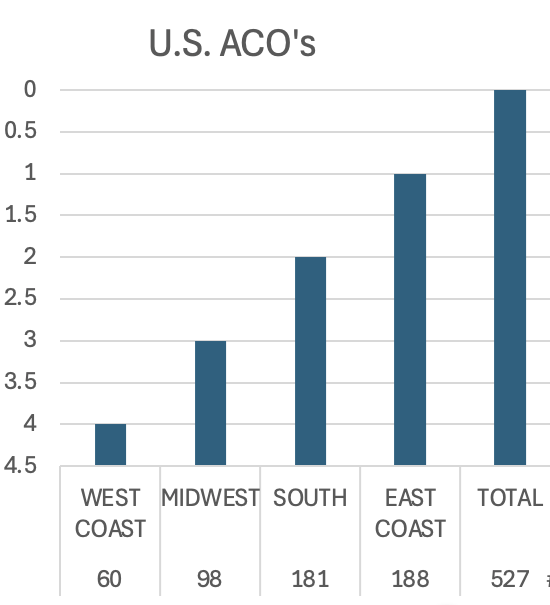
Figure 1.1 — United States Accountable Care
Organizations per Region
INDEX
WEST COAST: 60 Facilities
MIDWEST: 98 Facilities
SOUTH: 181 Facilities
EAST COAST: 188 Facilities
TOTAL: 527 Facilities
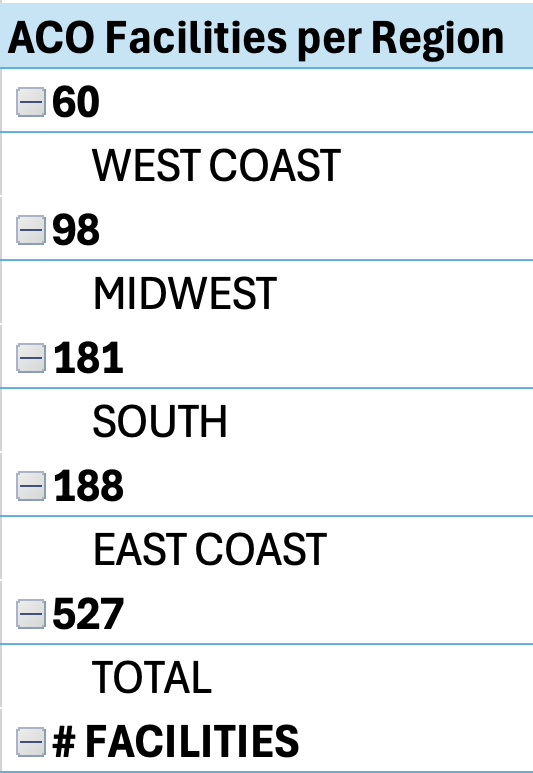
Figure 1.2 — United States Accountable Care
Organizations per Region
2. Federally Qualified Healthcare Centers are a type of facility focused on the comprehensive care & needs of the underserved — spearheaded through community involvement, as well as public — private partnerships. Students matriculating into; Dentistry, Medicine, Pharmacy, Nursing, Social Work, Counseling, Psychiatry, Therapy, Administration, Health Education, Billing, Medical Coding, Medical Quality Improvement, Compliance, Clinic Management, and Decision Making teams will find this opportunity beneficial.
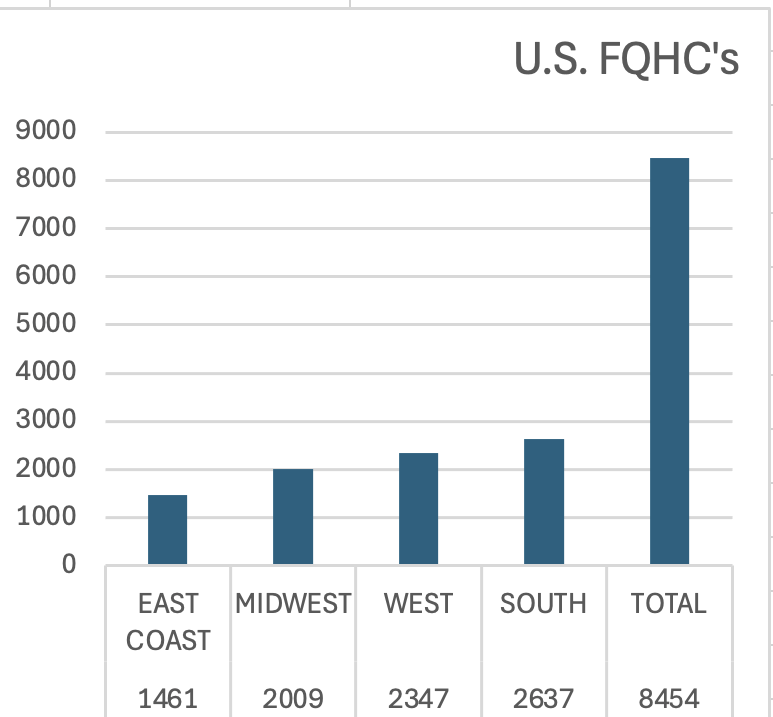
Figure 2.1 —
United States Federally Qualified Healthcare Centers Per Region
INDEX
EAST COAST: 1461 Facilities
MIDWEST: 2009 Facilities
SOUTH: 2,637 Facilities
WEST COAST: 2,347 Facilities
TOTAL: 8,454 Facilities
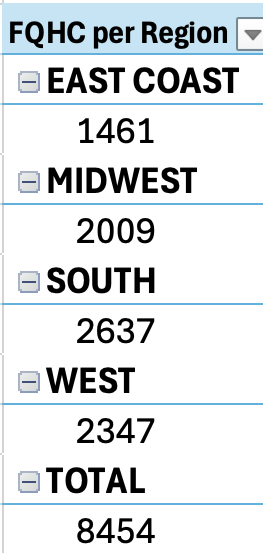
Figure 2.2 —
United States Federally
Qualified Healthcare
Centers Per Region
3. Home and Community Based Services are a mechanism of the U.S. healthcare system which provide long-term care services within a home or community based setting. Spearheaded by the federal Medicaid program coined The Medi-Cal program, reimbursement is made through the Inpatient Prospective Payment System (IPP). Care is compensated based on patient classification vs outright/actual costs, this system working to encourage efficiency by providing pre-disclosed payments for each patient's treatment. *It is important to note, the setting must be integrated in and supports the client having as much access as possible to the broader community. Within this branch of care the possibility is only extrapolated with,“86.2% of long-term care patients receiving services and support”, from this type of facility according to CMS. Students matriculating into; Nursing, Physical/Occupational Therapy, Speech Language Pathology, Health Aid, Direct Support, Social Work, Counseling, Administration, or Service Coordination will find this opportunity beneficial.
4. Sickness Funds are an international healthcare system that utilizes an insurance system called, ‘sickness funds’, which are financed by employers/employees through a payroll deduction. The uniqueness of this organization type can be understood in the fact an overall profit or revenue within this healthcare system is not generated from operations and must cover everyone. This opportunity will provide students within a service learning structure a comparative analysis of health systems across countries. Students matriculating into; Customer Service, Claims Processing/Reviewal, Case Management, Nursing, Medicine, Medical Consulting, Rehabilitation, Actuarial Sciences, Auditing & Accounting, Finance, Law, Cybersecurity, Information Technology, Data Science, Managerial, and Decision making roles will find this opportunity beneficial.
Service Learning, Healthcare Delivery & Financing Models: Under the Guise of Analytics
Healthcare delivery systems and finance models function as the unofficial ‘Atlas’ of service disbursement across related specialities. Service learning is a primary forerunner to become a pillar of pedagogy in an industry experiencing significant shifts such as; Value Based Care, Individually-Directed Goods & Services, and compliance related issues. ACO’s, FQHC’s, HCBS’s, and Sickness Funds alike all share elements of patient centered care amongst interdisciplinary teams within a community - based patient directed format.
Service learning is driven through community engagement, with clearly defined learning outcomes and communal reciprocity. The foreground for the hybridization of these two entities is within a health professional shortage area, with an emphasis on healthcare delivery systems. The brokerage of a partnership offers an unparalleled experience amongst scholars, interconnecting the community and stimulating fresh creative capital across market sectors. The involvement of community partners, crafts an identity of a principle-centered partnership amongst communities and health professions schools, (Hopkins). With the application of an expansive analytic service such as Artificial Intelligence; data processing, initiative scalability, and front-end user accuracy will only lead to the expansion of workforce capabilities/specialty.
The value is palpable, and of a direct interest to nations when considering the fact that labor productivity is influenced by human capital & technological changes — countries are literally measured by how smart their workforce is. Economic growth and desired productivity analysis reporting can only be achieved with the careful curation of academic content/related experiences. Service learning can work to strengthen the workforce, model successful community engagement frameworks, and expand student exposure to different types of professions. ‘SLAnalytics’, becomes our backbone and mechanism of interoperability with Application Programming Interfaces, ETL functions and specialized data flows doing the hard work for us. Setting the tone for a data driven, experiences focused, and a communally engaged initiative revolutionizing higher academia.
Community engagement is in the age it needs to become data driven, through the optimization of analytical processes via A.I. to be paired with related data into more comprehensive data sets. Having a quality data management system such as ‘SLAnalytics’, is a great start — insulating from A.I. related risk by encouraging technological advancement. Service learning in the healthcare context shifts into definitions focused on serving to learn, in this case becoming reminiscent to phrases such as ‘Praxis kai Logos’’. Or treating with hands (serving) and by speaking magic words (community engagement).
The Value in this A.I. Initiative — An Intrinsically Iterative Approach
These shared themes of interconnectivle nature and complexity of the healthcare industry/SLAanalytics as a whole lead me to believe this to be the true mechanism of standardization aimed at streamlining industry fragmentation. Working as a foundational analytics driven approach targeting early education professionals.
The curriculum by design working to integrate/address key in-discrepancies within foundational literature aimed at bolstering the community standards of quality or access related to care.
The most integral area to troubleshoot the use of A.I. facilitated SLAnalytics is the outright requirements of capital to design, scale, and integrate such a model. With the lapse of relative multi - sector interconnectivity required to deploy such an analytics initiative.
Artificial Intelligence does require the inclusion of environmental engineering to not only address the propensity for adverse environmental effects, but also redesign whole facilities operational systems. This could work as a leading precipice for subject matter reviewed by academics and engineers alike to further boost these processes.
Understanding the macro-level frameworks that underpin STEM service learning and higher education disciplines is essential to evaluate under the context of its long-term development. Any discussion of sustained interest must account for technological innovation, particularly under the context of artificial intelligence. What encapsulates my interest is the growing influence of Artificial Intelligence in contemporary analytical methodologies that directly denotes industries to adapt in ways that enhance operational effectiveness, foster innovation, and reduce susceptibility to exclusionary practices. Within the future I see healthcare as a multi-agentic approach with data driven dashboards, facilitated by encompassing software — evidently exciting when reviewing the opportunities for preventative medicine structures facilitated by H.I.T.
Conclusion
As a framework service learning is not absent amongst the higher academic community, with more than 50% of higher education institutions have some form of service learning programming. In this context, the oneirically catalyzed organization makes use of its resources, & communicates its value despite projected market changes. ‘SLAnalytics’, is a direct mechanism to do so, with a primary point of contact being the healthcare sector. In this application, working across healthcare delivery systems to developmentally enable students with specialized job exposure —as a structure strengthening the workforce & increasing specialization amongst domestic human capital. Scalability will work to communicate value and as a precursor, this type of programming can even matriculate into settings such as RHC’s or Rural Health Clinic and Health Service Corps. An interconnected community can now be fueled by expansive internally interoperable technology.
References
1. Centers for Medicare & Medicaid Services. (2021, May). ACO operational elements toolkit. U.S. Department of Health and Human Services. https://www.cms.gov/priorities/innovation/media/ document/aco-operational-elements-toolkit
2. Centers for Medicare & Medicaid Services. (n.d.). CAHPS Home and Community-Based Services survey. https://www.medicaid.gov/medicaid/quality-of-care/quality-of-care-performance measurement/cahps-home-and-community-based-services-survey
3. Centers for Medicare & Medicaid Services. (n.d.). Federally qualified health center enrollments. U.S. Department of Health & Human Services. https://data.cms.gov/provider-characteristics/hospitals and-other-facilities/federally-qualified-health-center-enrollments
4. Centers for Medicare & Medicaid Services. (2024, May). Understanding budget authority in self directed home and community-based services. U.S. Department of Health & Human Services. https://www.medicaid.gov/home-community-based-services/downloads/undrstnd-bdgt-athry-slf drcted-hcbs-may-2024.pdf
5. Commonwealth Fund. (n.d.). Germany: International health care system profiles. https:// www.commonwealthfund.org/international-health-policy-center/countries/germany 6. DigitalOcean. (2024, July 11). What is AI analytics? Harnessing the power of artificial intelligence for data analysis. https://www.digitalocean.com/resources/articles/ai-analytics
7. Dillender, M., Friedson, A., Gian, C., & Simon, K. (2021). Is Healthcare Employment Resilient and "Recession Proof"?. Inquiry : a journal of medical care organization, provision and financing, 58, 469580211060260. https://doi.org/10.1177/00469580211060260
8. Harlow, D. (2011, April 1). Accountable care organizations and patient-centeredness. Society for Participatory Medicine. https://participatorymedicine.org/epatients/2011/04/accountable-care organizations-and-patient-centeredness.html
9. Healthcare Financial Management Association. (n.d.). AI revenue cycle transformation. https:// www.hfma.org/revenue-cycle/ai-revenue-cycle-transformation/
10. Health Resources and Services Administration. (2026). NHSC HPSAs practice sites. U.S. Department of Health and Human Services. https://bhw.hrsa.gov/sites/default/files/bureau-health-workforce/ workforce-shortage-areas/nhsc-hpsas-practice-sites.pdf
11. Health Resources & Services Administration. (n.d.). Health professional shortage areas (HPSAs). U.S. Department of Health & Human Services. https://bhw.hrsa.gov/workforce-shortage-areas/ shortage-designation#hpsas
12. Johns Hopkins University. (n.d.). What is service-learning? SOURCE Service-Learning Toolkit. What is service-learning?
13. Mitchell, T. D. (2008). Traditional vs. critical service-learning: Engaging the literature to differentiate two models. Michigan Journal of Community Service Learning, 14(2), 50–65. https:// files.eric.ed.gov/fulltext/EJ831374.pdf
14. Physicians for a National Health Program. (n.d.). Health care systems: Four basic models. https:// www.pnhp.org/single_payer_resources/health_care_systems_four_basic_models.php 15. Prombs. (2026). Inpatient prospective payment system: How IPPS works (2026 guide). https:// prombs.com/inpatient-prospective-payment-guide-2026/
16. Ward, A., & Zinni, B. (2024, September 16). Measuring labour input: Is it about quantity, quality, or both? OECD Statistics Blog. https://oecdstatistics.blog/2024/09/16/measuring-labour-input-is-it about-quantity-quality-or-both/

Hannah B. Thomas is a student member with The International Association of Business Analysis. Prior to joining The IJRSLCE, she was an active member of the CAQH, HFMA, People to People and Disability:IN. Ms.Thomas speaks English, Spanish, and is professionally conversational in German. Her research interests include; Exchange Rate Mechanisms, A.I. Arbitration, Gesundheitsfonds (German Central Pools), deal structuring, financial accounting, valuation/risk analysis and Mergers & Acquisitions. Ms.Thomas previously oversaw health services administration of clients in The Metro-Detroit non-profit Freedom House Detroit as a Case Management Intern. In that capacity, she introduced innovations to decision making teams on analytical cross-platform strategies to facilitate process improvement for the case management team. Prior to her tenure within the 501 organization, Hannah facilitated formulary management, program enrollment, and coordination of member benefits for Blue Cross Blue Shield of Michigan. Before joining BCBSM, Hannah worked at Medivera Compounding Pharmacy and OneCare LTC—where she gained essential knowledge on specialty pharmaceutical services. Hannah is a member of the 2026 standing committee of The Alliance for Pharmacy Compounding Association. She serves as a member of The IARSLCE GRAD SN, The Eli Broad Leadership Academy, and Disability IN: Next Gen Leaders Program. Hannah is currently pursuing her MSc in Healthcare Management with an emphasis on financial transactions, and holds a Bachelor of Science in Political Science from Grand Valley State University. In her free time she enjoys djing for family and friends — curating techno and deep-house soundscapes within the 128 t0 132bpm range.
Hannah’s headshot was captured via BWillVisuals LLC.